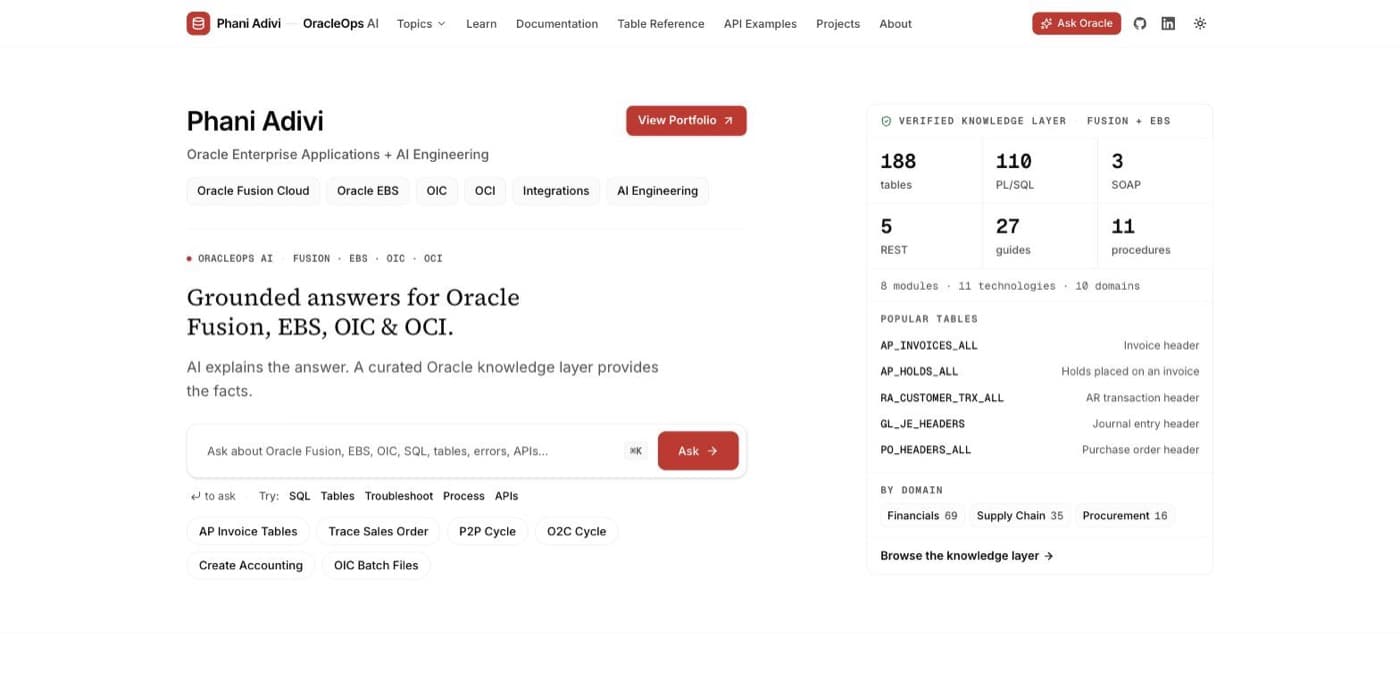
OracleOps AI
Oracle Fusion + EBS technical intelligence platform
Problem
Oracle knowledge is scattered across implementation guides, table references, SQL snippets and years of community posts. Finding the right table, the right SQL pattern, or the right troubleshooting path usually means digging through several disconnected sources. Generic LLMs can answer fluently, but they can also hallucinate table names, columns and navigation paths with total confidence.
Solution
OracleOps AI combines question classification, a curated Oracle knowledge layer, and LLM response generation, then renders the result through a typed answer schema instead of a raw chat bubble. The model still writes the explanation, but it's grounded against verified table/topic metadata retrieved for the question — and every answer carries an explicit confidence level instead of presenting a guess as fact.
Architecture
User question
   |
   v
Question Classifier (rule-based hint: type / product / domain / module)
   |
   v
Retrieval Layer -- curated Oracle metadata (tables, topics, verified SQL patterns)
   |
   v
LLM (grounded by retrieved context, forced into a structured JSON contract)
   |
   v
Zod-validated OracleAnswer
   |
   v
Typed answer renderer (SqlAnswer / TableAnswer / ProcessAnswer / ...)
Key Design Decision
“AI explains the answer. A curated Oracle knowledge layer provides the facts.”
Challenges
- Keeping Oracle table/column accuracy high without a large team maintaining documentation.
- Fusion and EBS share concepts but not always object names — answers have to keep them distinct.
- Making follow-up questions ('how do I join them?') resolve correctly against prior answers.
- Producing SQL that's actually runnable rather than plausible-looking.
- Retrieval quality: the curated layer needs to surface the right handful of tables, not everything.
Technology
Future Roadmap
- Replace keyword retrieval with pgvector-backed semantic search over a larger curated corpus.
- Ingest official Oracle documentation into the knowledge layer with source citations per answer.
- Expand curated metadata beyond AP/AR/Order Management into Procurement, GL and Manufacturing.
- Add a feedback loop so verified/corrected answers get promoted into curated data.